 Translate

Infectious Diseases
Infectious Disease Trend Report
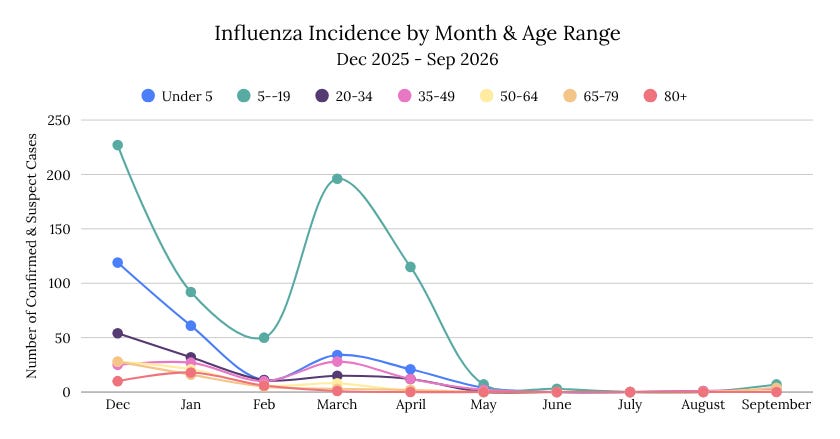
Signs of respiratory illness season are emerging! NBC saw 16 cases of influenza, the highest monthly total since April 2026. Almost half of these cases were seen in individuals aged 5-19 years.

COVID-19 cases are continuing to rise, with 27 new diagnoses in September across the region. The highest incidence was seen in individuals aged 20-34 years (n=8) and those under 5 (n=7).

September saw 12 foodborne illness diagnoses, a 43% decrease from July which had the highest incidence of foodborne illness (n=21). In 2026, the leading diagnoses across the region are Norovirus (n=34), Campylobacteriosis (n=27), and Salmonellosis (n=14). This distribution of disease is similar to that seen in 2025.

Hepatitis B continues to be the most prevalent communicable disease across the region. September saw 22 new Hep B diagnoses, bringing the monthly average for 2026 to 20.1 cases.

We are beginning to see a decrease in Lyme diagnoses across almost all age ranges. September saw a total of 43 new diagnoses, a 37% decrease from August (n=68).
We do continue to see the majority of cases in folks aged 50-64 years and 65-79 years. This is not necessarily indicative of these groups participating in higher-risk activities than younger groups, but rather their immune systems may just be more susceptible to the impacts of infection. Similarly, older folks may be more inclined to seek medical care for certain symptoms, while younger crowds may forgo testing for a multitude of reasons.